
Kai Art Center, Tallinn presents ‘Island Beyond the Sea’, a solo exhibition by Danish-Korean artist and filmmaker Jane Jin Kaisen. The exhibition is curated by Karin Laansoo. It brings together seven video works made between 2022 and 2024: ‘Burial of This Order’ (2022), ‘Offering’ (2023), ‘Halmang’ (2023), ‘Guardians’ (2024), ‘Portal’ (2024), ‘Core’ (2024) and ‘Wreckage’ (2024). This marks the first time the complete film cycle is presented together in Europe, as well as the artist’s first institutional solo exhibition in the Baltic States. The cycle takes Jeju, the volcanic island off Korea’s southern coast where the artist was born, as the site of an inquiry into memory, migration and the narration of history.
What distinguishes Kaisen’s practice is that she does not illustrate history; she performs with it. Working over many years with shamans, divers and island communities, she treats filmmaking as a form of ritual. Like Jeju’s shamanic tradition, her films hold past and present, the living and the dead, in continuous relation.
The cycle moves freely between the intimate and the cosmic, from the weathered hands of an elderly diver to the creation of the world. Kaisen draws on Jeju’s mythology to place women at the centre as keepers of knowledge. Among them are Seolmundae Halmang, the grandmother goddess whose body became the island, and the princess Bari, whom Kaisen reads not as a dutiful daughter but as a figure who crosses every border set for her. This lineage is also the artist’s own: her mother and grandmother dived Jeju’s waters alongside the haenyeo, the island’s women free divers. Their knowledge of the sea runs through the films, as does sochang, a long white cotton cloth from Korean rites of passage, spiralled across black lava, carried underwater and unfurled as a cord tying one generation to the next.
The island’s twentieth-century history, including the state violence of 1947–1954, is present in the work but never its endpoint. Kaisen’s question is less what was lost than how life returns: how memory is passed on, how relations are remade, how to begin again. Projected at architectural scale, the films are installed to be moved through rather than faced. Looking becomes a form of acknowledgement, what Kaisen calls “translating otherwise”, through which silenced histories can be recognised anew.
The following is a recording of a public artist talk held in front of a live audience on 17 October 2026 at Kai Art Center, as part of the exhibition an ’Island Beyond the Sea’. The conversation features the exhibition’s curator, Karin Laansoo, and artist Jane Jin Kaisen.
You can also listen to the audio recording of the conversation here:
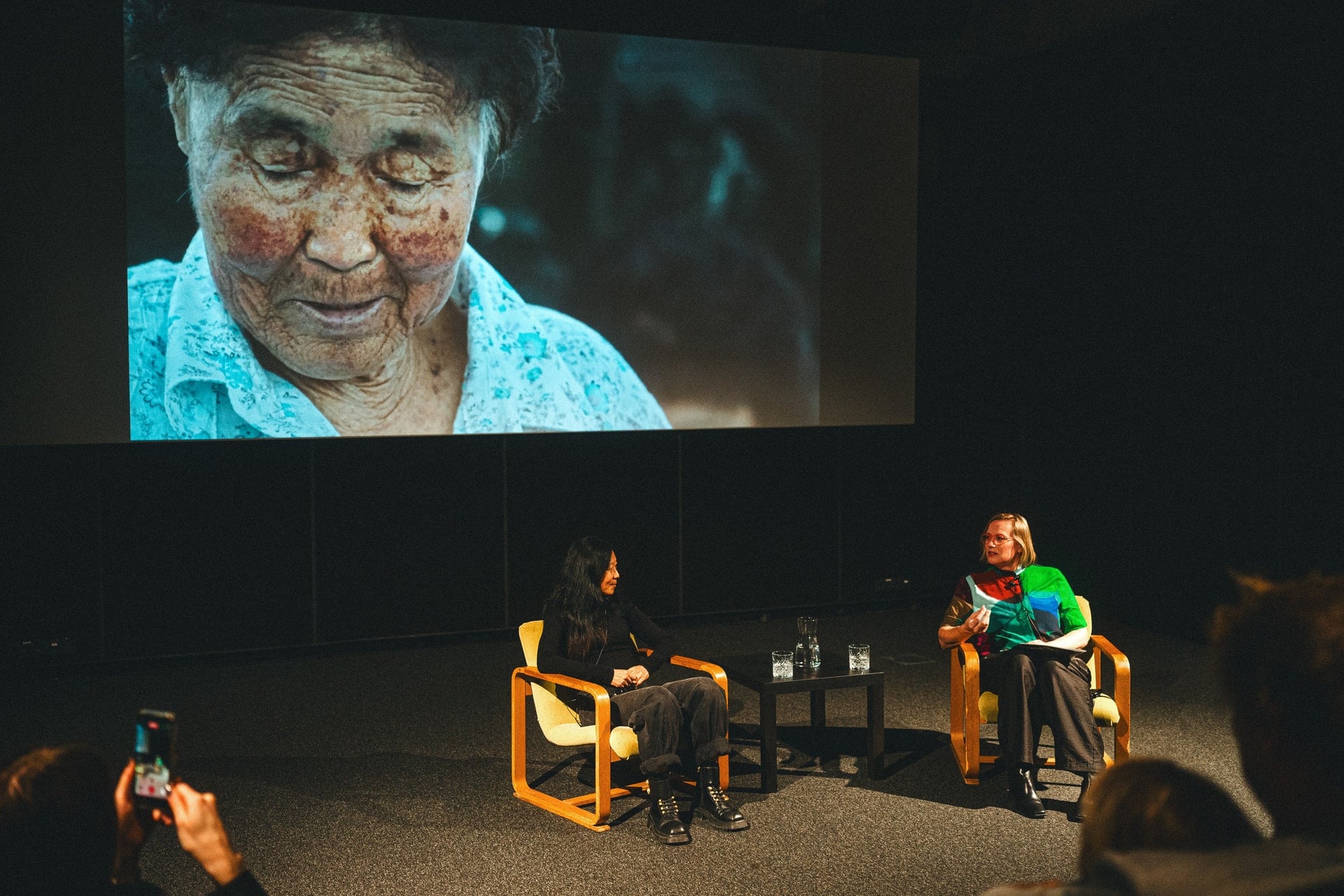
Photo: Marek Metslaid
KARIN LAANSOO: You are an internationally recognized artist and filmmaker, and this remarkable series of films shows you at a particularly compelling moment in your practice. To begin, I’d like to look back about 20 years. Was there a meeting, an experience, or perhaps a coincidence that had a defining influence on your career?
JANE JIN KAISEN: I would probably locate a defining moment in my life in my return to Korea when I was 21. I was adopted from Korea to Denmark as a very young child, and just before starting art school, I had the opportunity to return. I was able to find my birth family, who live on Jeju Island. This was in 2001, when a growing number of transnational adoptees like myself were beginning to return to Korea to contest and renegotiate official histories of transnational adoption, both in Korea and in the Western countries where we had grown up. I think these two experiences—meeting my birth family and visiting Jeju, but also becoming part of the social justice activism surrounding transnational adoption—really shaped the direction I began to take as an artist. All of this coincided more or less with my time studying at the Royal Danish Academy of Fine Arts.
KARIN LAANSOO: Was that when your relationship with Jeju began? Do you remember some of your earliest works or films connected to the island? And did you have any sense then that Jeju would become the subject of decades of research and artistic work?
JANE JIN KAISEN: No. When I first went to Jeju, it was primarily to see my family. I think the first time Jeju featured in my work was in my performative experimental film ‘Accentuation’ from 2005, which is a quite personal film that also interweaves quotes from the Danish fairytale writer H.C. Andersen. Jeju has a very particular place within Korean history and my deeper engagement with the island’s history and culture came later around 2008 or 2009 when I began working on ‘Reiterations of Dissent’ (2011/2016), an 8-channel video installation and film about the history and memories of the Jeju April 3 massacre which unfolded between 1947-1954 and which was silenced for many years. That was also when I first met shamans on Jeju and began observing ritual practices, including commemorative rituals for people who had died during the massacre. That work began around 2008–2009 when I started interviewing many people in Jeju, primarily children of victims and survivors who were involved in the truth and reconciliation process and commemoration about the Jeju massacre. That film took a number of years to complete and it involved extensive filming, dialogues with people and archival research.
KARIN LAANSOO: You mentioned Jeju’s distinct place within Korean culture, and I’d like to return to its spiritual traditions and the important role of women on the island. In ‘Halmang’, one of the films in this series, we see a group of women in their seventies and eighties sitting on volcanic rock, carefully tending to a long white cloth. These are the haenyeo, Jeju’s women divers, whose centuries-old practice has sustained families and coastal communities. Girls once began diving at a very young age, and many women continued into their seventies or eighties. Historically, their work was seen as hard, working-class labor; today the tradition is internationally recognized, including by UNESCO, even as it becomes increasingly vulnerable. Your mother and grandmother were both divers. What does this inheritance mean to you? And how do you understand therelationship between the practical and economic power of women in Jeju’s coastal communities and the more traditional structures often associated with island cultures? In Estonia, Hiiumaa might offer a distant point of comparison, although the scale and history are very different.
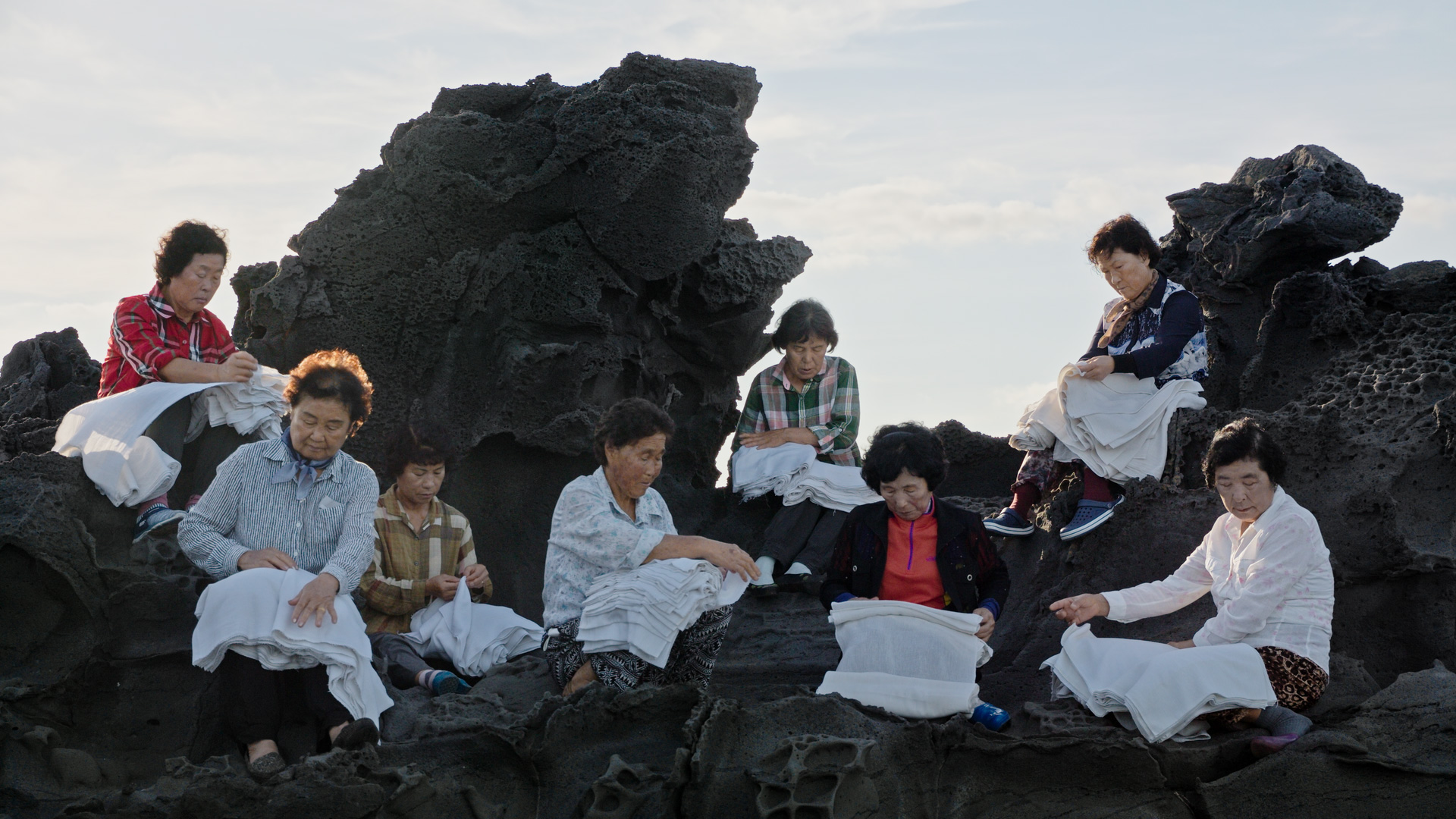
Jane Jin Kaisen ‘Halmang’ (2023)
JANE JIN KAISEN: Haenyeo culture is something I have returned to over the years in different forms, partly because the practice, at least as it has been known for centuries, is disappearing. That has made me look at it with new eyes. For women of a certain generation who grew up in coastal villages, diving was very common. That was true of my mother and grandmother as well. I was drawn not only to the practice itself but also to the haenyeo‘s significance within coastal communities and their important role in labor resistance during the colonial period—something that has perhaps only more recently received wider attention in Jeju and Korea. As you say, Jeju is an island; it is an oceanic culture. Haenyeo practices, and the underlying ethos of Jeju’s spirituality, culture, and cosmology, are deeply connected to that reality. More broadly, I’ve been thinking about practices across many cultures that are vulnerable to disappearing in the forms they have taken for generations. We can see similar changes in other island cultures in Asia, and that is something I’ve also become interested in exploring.
KARIN LAANSOO: I’m struck by how aware we are that this tradition is disappearing. Perhaps there will be another generation of haenyeo, but in 50 years it may be something people encounter mainly through written accounts and archival footage. Over the years you have filmed and collected an extensive archive. How do you think about that material as an artist? Do you already imagine future works emerging from it, and what kind of responsibility do you feel toward it?
JANE JIN KAISEN: When I am in Jeju I film a lot. It is a way of sense-making and I almost can’t help but doing it. I have kept material I have filmed since the early 2000s and it has become a growing archive. With some material it has taken me many years before I could understand where it belongs or what it can speak to. One example in the exhibition is the shamanic lament heard in ‘Wreckage’. I recorded it in 2015, but only toward the end of editing the film, which is from 2024 did I recognize where the voice of shaman Koh Sunahn whose practice I documented since 2011 and until her passing, could resonate. It could speak both to this military history and to the ocean as a space not only of regeneration but also of traumatic memory connected to the Jeju massacre. Her lament became a voiceover juxtaposed with archival footage filmed by the U.S. military after Korea’s liberation from Japanese colonial rule, when U.S. forces arrived on Jeju. When I look back now at material I filmed in 2005, 2008, 2010, or 2012—often of shamanic practices on Jeju—it carries different connotations. Some of the rituals, for instance, are no longer performed because there are fewer and fewer participants and some shrines have been demolished by real estate development and the impact of tourism. That raises the question of what this visual material can do. I don’t have a straightforward answer, but perhaps it acquires another kind of significance over time.
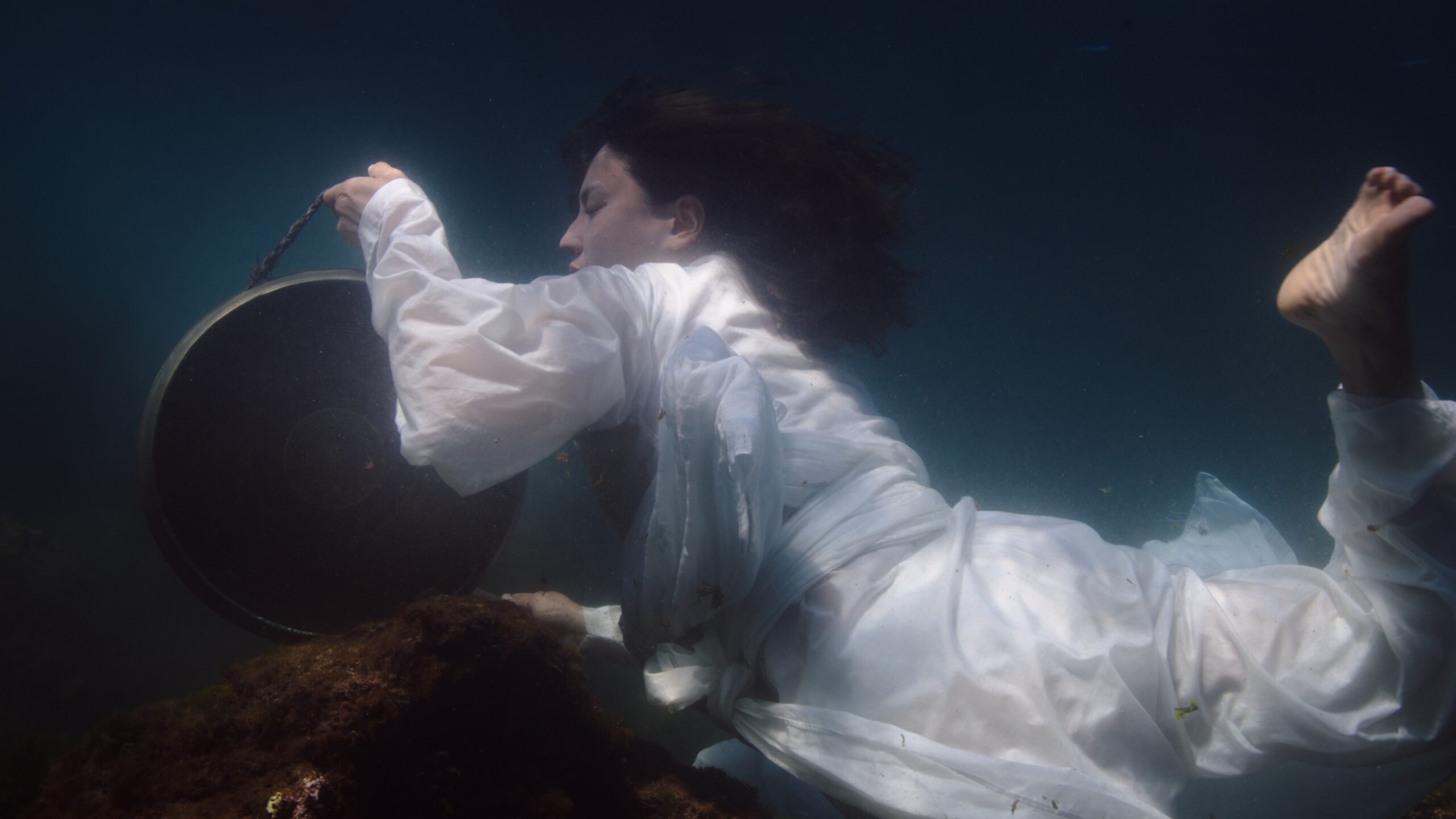
Jane Jin Kaisen ‘Wreckage’ (2024)
KARIN LAANSOO: You mentioned ‘Wreckage’. One of its most striking aspects is how you layer U.S. military footage from 1945 with other images and voices. You found that material through an archive in the United States, didn’t you? Do you remember when it became accessible?
JANE JIN KAISEN: I’m not sure exactly when it became publicly accessible. I first encountered it about fifteen years ago, when I met a local historian on Jeju. He had travelled with a delegation from the Jeju April 3 Research Institute to the U.S. National Archives to look for footage and visual evidence of the massacre and the United States’ role in it. He showed me a very low-resolution copy on his laptop and I spent a long time afterwards trying to locate the film in the archives. One of the fascinating but also frustrating things about archives is that you often can’t simply go in and locate the material you’re looking for. In this case, Jeju was catalogued under the Japanese name for the island rather than Jeju Island or Jeju-do, which made it especially difficult to find. Eventually I was able to retrieve it. Many people had told me stories about what the footage depicts: Japanese weapons—cannons, guns, tanks, and other artillery—being gathered after the war. Some are burned on land, while much of the material is loaded onto a large ship and dumped into the sea, left to rust and erode. People also told stories about weapons drifting with the currents and washing up along coastlines, sometimes as far away as Japan. There’s something about the sheer pointlessness of throwing these weapons into the ocean, and imagining them slowly rusting beneath the surface, the slow violence, that became a very powerful image for me.
KARIN LAANSOO: In ‘Wreckage’, the shaman’s lament moves between the voices of a mother and a son. You place that alongside historical footage that speaks to profound trauma. I’d like to ask more about shamanic rituals and the ways they can hold, express, or work through histories of violence. When did your connection to Jeju’s shamanic traditions begin, and what should an audience unfamiliar with them understand about their significance?
JANE JIN KAISEN: My first encounter with Jeju’s shamanic culture came while I was filming another project about the history and memory of the Jeju massacre. People kept telling me that I should meet the shamans because they were closely involved in this history. In particular, they urged me to meet a woman who practiced as a shaman in my grandparents’ home village and who had actually been an elementary school student of my grandfather. Her father had been killed during the massacre, and she consistently addressed its victims in her rituals. I think of her as having a profound commitment to marginalized memory—to the histories and experiences that could not be spoken about publicly for so many years, because the massacre was effectively silenced for decades.
JANE JIN KAISEN: People could not openly talk about what had happened, who had died, or how they had died. Yet during rituals, the names of the dead could be spoken. My friend and colleague Kim Seongnae, a scholar of Korean religion and expert on Jeju shamanism, has described ritual as a kind of limited or semi-public space in which these memories could be negotiated when they could not enter the official public sphere. After the massacre began to receive official recognition in the early 2000s, shamans started travelling to villages across the island to perform rituals at places where people were known to have died. These practices continue today, especially around April 3, the annual day of remembrance. In that sense, shamans remain active participants in Jeju’s culture of memory.
KARIN LAANSOO: I find it moving that before visitors encounter the films, they see a photograph titled ‘Offering for Koh Sunahn’, a work dedicated to a shaman who was very important to you. One of the films with the related title ‘Offering’ takes place underwater, and the images are mesmerizing. You make the process look effortless, although I imagine it was anything but. Could you take us behind the scenes? What goes into filming in the ocean, with a team working at the mercy of water, wind, and the elements?
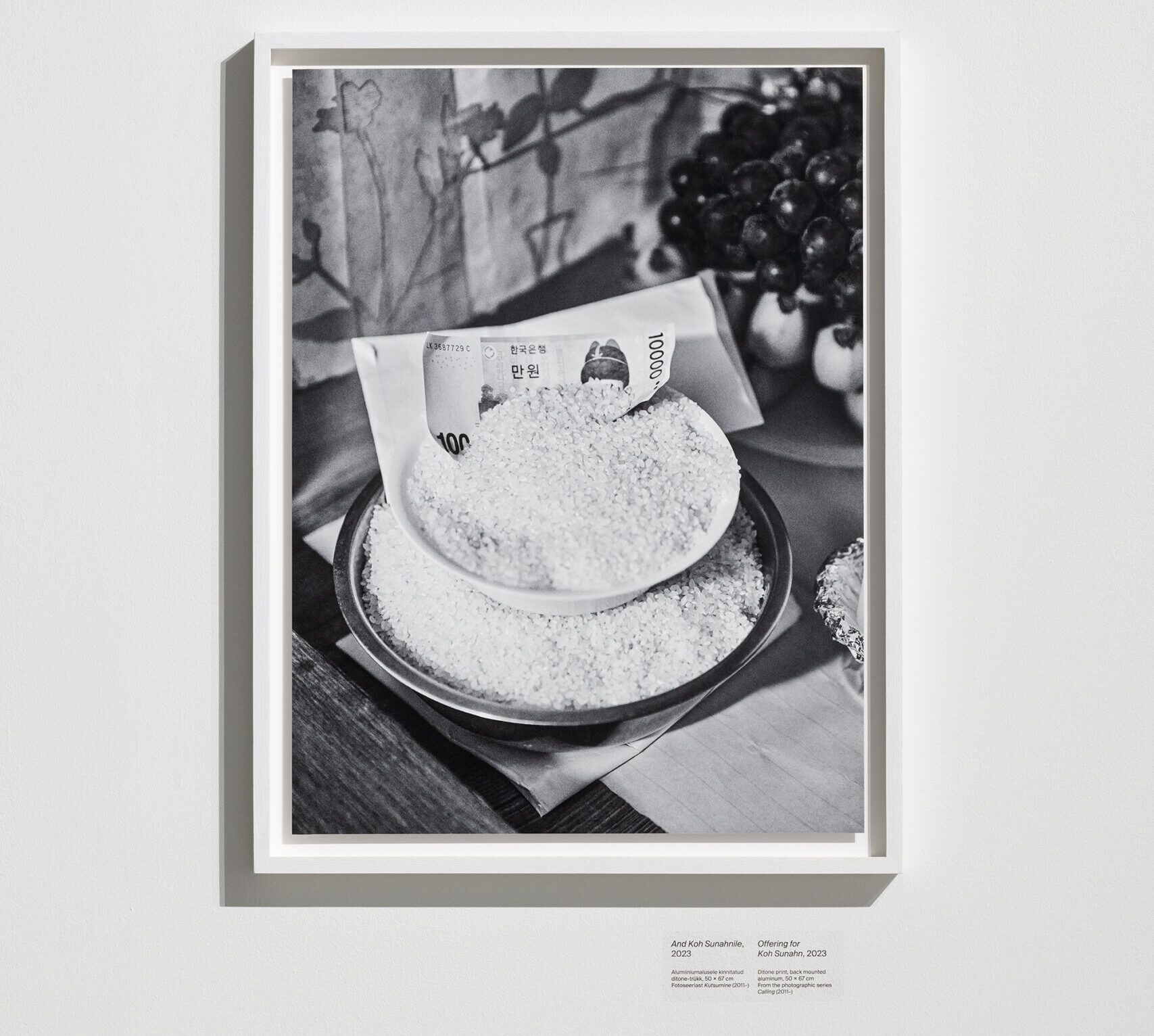
Photo: Paul Kuimet
JANE JIN KAISEN: I’m laughing a little because Soyoung Kwon is in the audience, and she’s been such an important part of making these works. She knows just how much work has gone into them. One of the beautiful things about filmmaking is that it is such a collective effort. There is a great deal of preparation: location scouting, working with participants, and, in the case of underwater filming, developing new skills and ways of working. Filming underwater is an entirely different experience. We were very fortunate to collaborate with so many people on these films. Something else that was important to me is that the works were shot in different environments, mostly outdoors, where you can’t control the weather. Jeju has strong winds and typhoons; the elements are constantly at work.The question becomes how to respond to those conditions and allow them to become part of both the process and the image. For ‘Offering’ and ‘Wreckage’, the two underwater films, we filmed intensely for two weeks with a team of roughly ten people, both behind the scenes and in the water. There were safety considerations, and we had to custom-build a camera setup to film in this particular way. Then, of course, there is all the post-production and editing. But I enjoy that part of the work too, and especially the filming process.
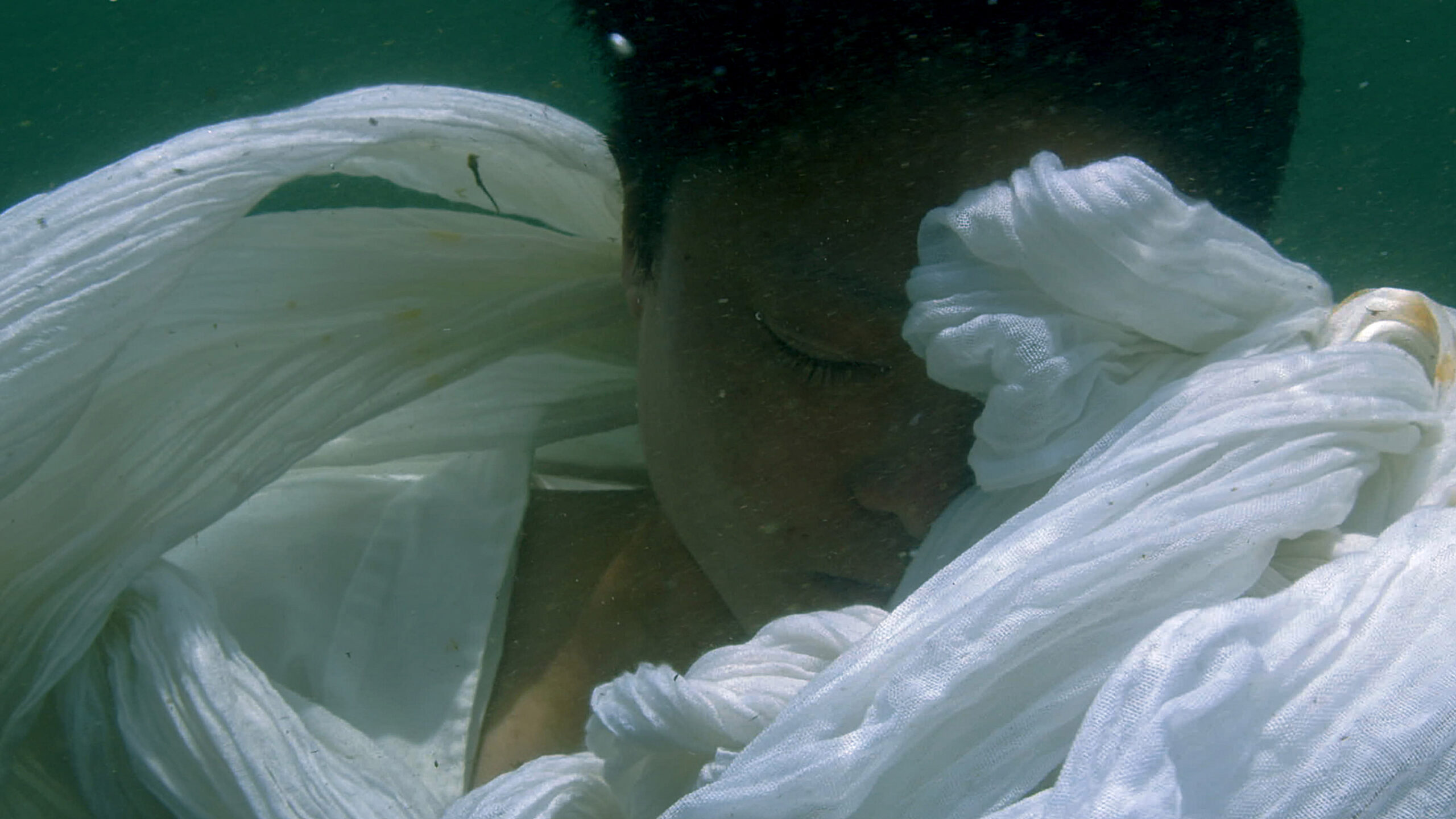
Jane Jin Kaisen ‘Offering’ (2023)
KARIN LAANSOO: The footage you brought back is extraordinary. How closely did the finished films resemble what you had imagined before you began shooting?
JANE JIN KAISEN: For me, there is usually an idea or an image that guides the process. Some films are more tightly conceived in advance, while others develop more organically. I tend to shoot far more footage than I can use. Take ‘Portal’, for instance, which is built around macro images filmed within a very small area of water in the intertidal zone. Despite those narrow parameters, it is the work exhibited that took the longest to film — more than two years — and I think we ended up with perhaps 60 hours of footage for a 12-minute film. It’s not the most practical way of working, and the editing can be painstaking, but it’s a process I really enjoy. Other films, especially those made with participants, need more planning in advance, because you have to communicate and decide together how the filming will take place.
KARIN LAANSOO: One final question. Before visitors enter this world of Jeju, is there anything you’d like them to know? The spiral seems important to the exhibition’s spatial arrangement. Is there a particular way you’d encourage people to experience the works, or should they simply follow their instincts?
JANE JIN KAISEN: I wouldn’t want to prescribe a particular way of experiencing the films. It may help to know that there are seven distinct film works: six of them are 12 minutes long and one is around 24 minutes, and all are shown independently in a loop. There is a circular or spiral movement in the way the material is organized and in how the films are arranged in space. The exhibition is configured like a spiral—or an island—so visitors can move around freely. You don’t have to watch the films one by one, from beginning to end. Unlike some of my earlier, more narrative-based films, I think of these works in a more horizontal way: they can be experienced together and wherever you position yourself in the exhibition space, several screens are simultaneously in your field of vision. The exhibition allows you to see several films at once and hear sounds from the others, so you can orient yourself spatially rather than follow a single linear sequence. I hope people will allow themselves to become immersed and simply follow where their attention leads and embrace being active participants in how the images and stories unfold.
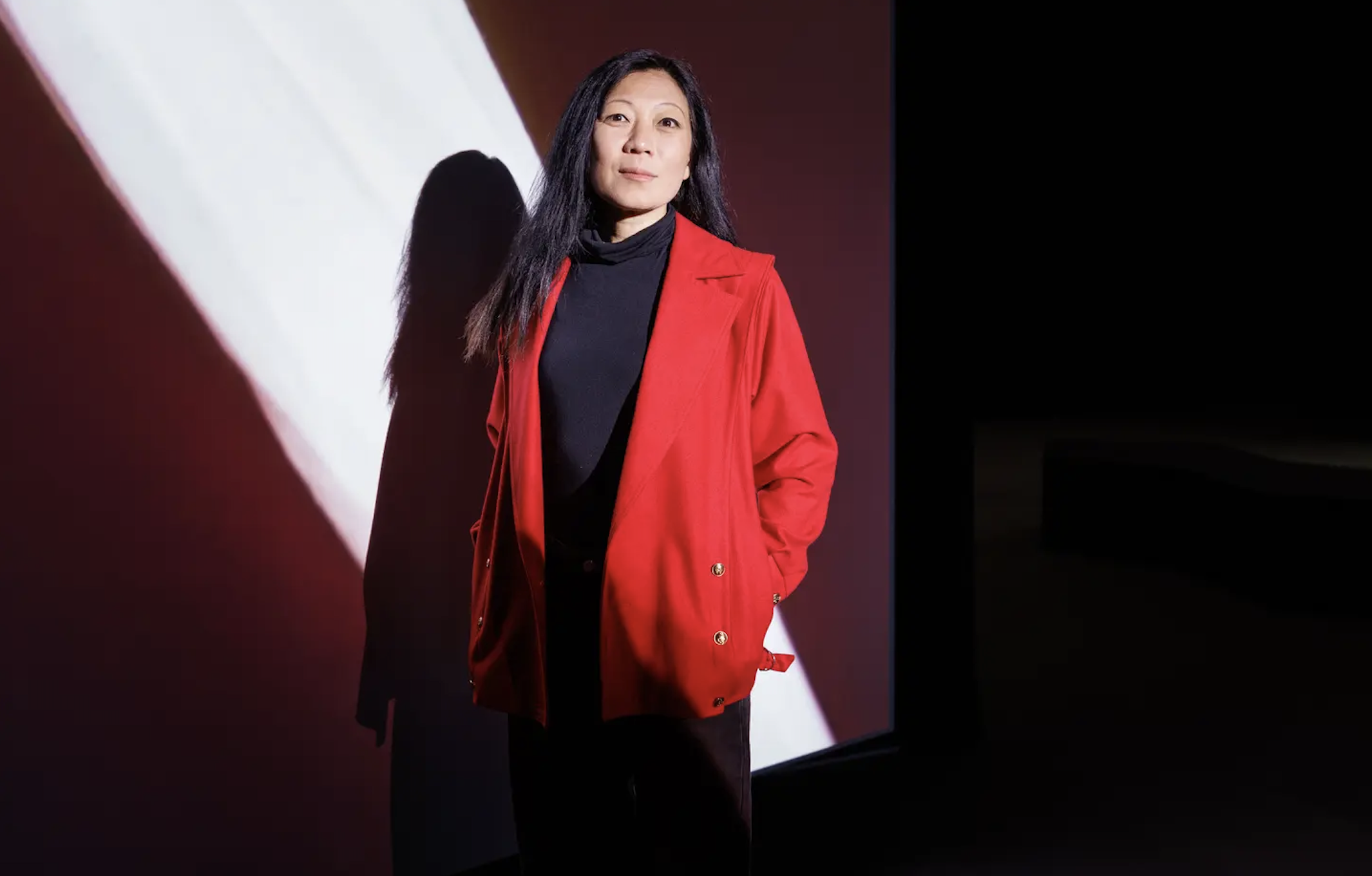
Jane Jin Kaisen, photo: Mihkel Maripuu / Postimees Grupp
Jane Jin Kaisen (b. 1980, South Korea; based in Denmark) is known for visually striking works that are layered, performative and poetic. Holding past and present side by side, her work traces how memory, migration, borders and translation shape individual lives, and how personal experience is bound up with the histories of nations. Kaisen represented Korea at the 58th Venice Biennale, and her exhibition Community of Parting at Kunsthal Charlottenborg was named Exhibition of the Year 2020 by AICA Denmark. Recent presentations include the Medina Triennial (2026), the 13th Berlin Biennale, the 13th Seoul Mediacity Biennale, the 36th Ljubljana Biennale of Graphic Arts and the Hawaiʻi Triennial (all 2025), the Korea Artist Prize 2024 at MMCA Korea, and Dislocation Blues at Tate Modern (2023). She holds a PhD from the University of Copenhagen and an MFA from UCLA, and is an alumna of the Whitney Independent Study Program.
Jane Jin Kaisen’s first solo exhibition in the Baltic States, Island Beyond the Sea, is on view at Kai Art Center from 17 October 2026 to 21 February 2027. The exhibition is supported by the Korea Foundation, the New Carlsberg Foundation, the Cultural Endowment of Estonia, the Danish Arts Foundation, the City of Tallinn and the SBS Foundation Korea Artist Prize Promotion Fund.
Artist Talk was also published in Echo Gone Wrong magazine.